Quick home services ad spends surge as sector eyes ₹13.2 billion run rate by Dec
Industry experts see quick home services emerging as a major growth opportunity, with platforms stepping up marketing investments to tap festive demand and build year-round consumer habit
 by
Published: Oct 21, 2026 8:58 AM | 5 min read
 Follow Us
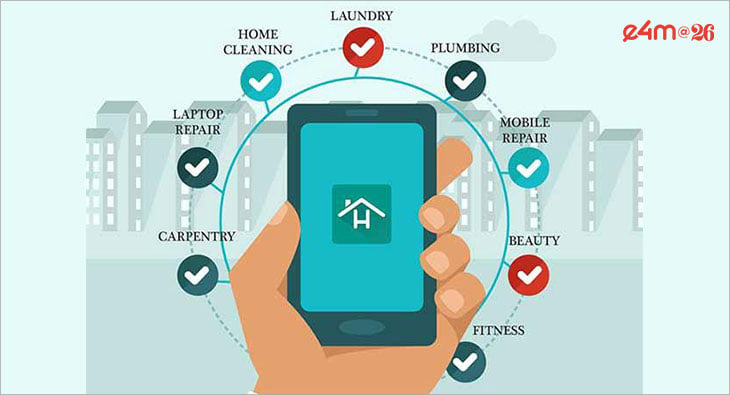

- The Indian festive season has seen a shift in consumer behavior, with urban residents increasingly seeking instant professional services, driving growth in the hyperlocal economy.
- A report by Redseer and Google predicts the quick commerce market will expand significantly, with the home services sector projected to grow from ₹26.4 billion in FY22 to ₹52.8 billion by FY26.
- Companies like Yes Madam and Snabbit are ramping up marketing efforts, with Yes Madam increasing its ad spend significantly and Snabbit partnering with JioHotstar for brand visibility, despite facing high customer acquisition costs.
- Investors remain optimistic about the sector's potential, as platforms like Pronto secure funding and expand their services, aiming to formalize India's informal labor market.
Whether it is preparing the house for Diwali guests, getting a last-minute salon treatment before a Durga Puja pandal visit, or calling for instant deep-cleaning after a party, the Indian festive season has fundamentally shifted. Urban consumers are no longer just relying on quick commerce for last-minute grocery deliveries; they are increasingly seeking instant professional help.
This behavioural shift is driving massive growth—and heavy marketing investments—in India’s hyperlocal economy. According to the recent "Think Quick Commerce: Unlocking the 90B opportunity" report by Redseer and Google, the broader quick commerce market is projected to surge from ₹1,144 billion in FY26 to an astronomical ₹6,160–₹7,920 billion by FY31.
Within this, the home services sector—encompassing on-demand repairs, cleaning, and at-home beauty—has already doubled in size, growing from ₹26.4 billion in FY22 to ₹52.8 billion in FY26. Driven by a 21% compound annual growth rate (CAGR), "quick home services" are forecast to reach an annualised run rate of ₹8.8–₹13.2 billion by December 2026.
Read On: Has the scaling of quick home services opened a new frontier for marketers?
This evolution is distinctly metro-led. While early quick commerce adoption in non-metros remains heavily skewed toward groceries (79% of the category mix), metro consumers are diversifying. Non-grocery spends in metros are projected to leap from ₹264 billion today to between ₹1,848 billion and ₹2,376 billion by FY31, a 44-51% CAGR, indicating that urban consumers are firmly embedding lifestyle and on-demand services into their daily habits.
Aggressive marketing and high-decibel integrations
To capture this expanding urban wallet, service platforms are executing high-visibility brand integrations and aggressively ramping up their advertising budgets.
At-home salon platform Yes Madam has increased its ad and promotional spends by nearly four times, deploying around ₹27 crore into marketing in FY25. Moving away from standard media buys and previous celebrity-led campaigns featuring Shraddha Kapoor and digital creators, the brand is now leaning heavily into experiential, hyperlocal marketing.
During Raksha Bandhan, the platform executed a heavy print and out-of-home (OOH) blitz across 20 Delhi Metro stations, and for Durga Puja, it erected a giant "Sindoor Ki Dabbi" installation at Kolkata's prominent Singhi Park pandal.
View this post on Instagram
“Our festive spends have been scaling over the years as we continue to strengthen our brand presence through different campaigns and activations,” said Akanksha Vishnoi, Co-founder and CMO, Yes Madam. “This year, our approach has been to build on familiar traditions and cultural insights to create campaigns that resonate with audiences and help us establish a stronger connection with consumers.”
The strategy is yielding commercial results: Yes Madam’s annual revenue jumped from ₹45.8 crore in FY24 to ₹92.5 crore in FY25, and it has now reached an annual revenue run rate of ₹402 crore, clocking over 3.5 lakh home visits monthly.
Read On: Why conversational AI is now the new face of eCommerce
Similarly, quick home services platform Snabbit, which recently surpassed 1.5 million monthly service jobs, executed its largest brand integration to date by partnering with JioHotstar for Bigg Boss Hindi Season 20. The startup deployed its rapid-operating model to clean and prepare five key areas of the house in just four days prior to the premiere.
"Four days ago, this was just an idea on a whiteboard. Today, Snabbit is live on Bigg Boss in our biggest brand integration yet," said Aayush Vyas, Head of Brand Marketing, Snabbit, noting the integration's role in taking the brand into millions of households. "We’re excited to make Snabbit a habit for urban India."
View this post on Instagram
The cost of customer acquisition
However, capturing market share in this hyper-competitive space comes at a steep price. As Snabbit battled rivals like Urban Company’s InstaHelp and Pronto, its customer acquisition costs ballooned.
The startup spent Rs 49 crore exclusively on marketing and advertising in FY26. Consequently, total expenses surged to Rs 195 crore, widening Snabbit's net loss to Rs 168 crore in FY26, up from Rs 5.7 crore the previous year. Despite operating revenue growing sharply to Rs 12.25 crore—driven primarily by Rs 10.82 crore in platform services—the unit economics remain challenging: the company spent Rs 15.92 to generate every single rupee of operating revenue.
View this post on Instagram
Capitalising on informal labour
Investors, however, remain bullish on the sector's long-term potential to formalise India's unstructured domestic labour market.
In May, instant household services platform Pronto extended its Series B funding to $45 million after securing a $20 million investment led by Lachy Groom. The capital injection doubled the company's valuation to $200 million in a single month. To support daily bookings that have scaled from 18,000 to 26,000, Pronto expanded its workforce of background-verified professionals from 1,440 to 6,500, maintaining a utilisation rate of over 65%.
Read On: Quick commerce boom set to rewrite rules of India’s packaged F&B market?
The platform is already diversifying into car washing and gardening, and piloting home cooks in Bengaluru.
"Organizing informal labour is going to be one of the defining shifts of the next decade in services. It is also one of the harder problems in the consumer economy," said Anjali Sardana, Founder and CEO of Pronto. "The longer-term vision of Pronto is to be the world's largest labor organization platform."
As the festive rush stabilises into year-round urban demand, the battle lines are drawn. For CMOs in the quick service sector, the mandate is clear: spend aggressively on cultural relevance today to secure the habitual urban consumers of tomorrow.
Read more news about Marketing News, Advertising News, PR and Corporate Communication News, Digital News, People Movement News
For more updates, be socially connected with us onInstagram, LinkedIn, Twitter, Facebook, YouTube & Google News